
Pricing and Contact Information | ReConnect Counselling Southampton
At ReConnect, we aim to make accessing professional, compassionate support as simple and transparent as possible. Based in Southampton and serving the South Coast, we offer flexible counselling services tailored to individuals, children, young people, and families. Whether you’re looking for in-person sessions, online therapy, or home visits, we’ll work with you to find a solution that fits your needs. Below you’ll find our current pricing guide and how to get in touch. Please feel free to contact us directly to discuss your circumstances or ask any questions—your journey to emotional wellbeing starts here.
Free Resources
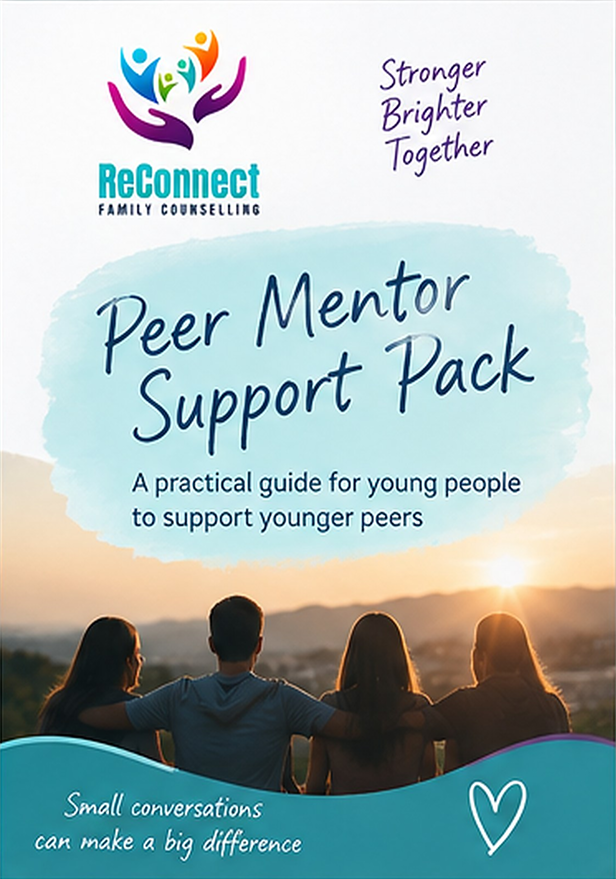
Peer Mentor Support Pack:
FREE DOWNLOAD
A practical guide for young people supporting younger peers, covering supportive conversations, boundaries, confidentiality and safeguarding, looking after their own wellbeing, and where to find further help
More Resources Coming Soon!
Keep checking back for more free resources coming soon, available for download from www.reconnect-south.co.uk.
Reflections & Articles
Neurodiversity, Labels and Individuality
A reflection on recognition, the expanding neurodivergent umbrella, and the importance of remaining curious.
A conversation that stayed with me
This reflection began, perhaps surprisingly, not in my professional life but in a conversation with a friend. It was one of those ordinary conversations that stayed with me long after it had finished, partly because it left me trying to make sense of how I felt.
I am fortunate to have a wonderful and wonderfully varied group of friends. Some of us have known each other for many years. We are organised and disorganised, studious and spontaneous, successful businesswomen, teachers, carers, thinkers, adventurers and everything in between. Some are spiritual, some pragmatic. Some seek excitement and challenge; others are happiest with familiarity and calm. Some remember everything.
I am definitely not one of those.
These differences have always been part of what I love about the people around me. They are the idiosyncrasies that make someone unmistakably themselves.
One of my closest friends is someone I would describe as beautifully dreamy. She can be forgetful and a little scatty. She is also peaceful, kind, thoughtful and considerate. These aren’t separate lists in my mind: the things she is good at and the things she is less good at. They are simply parts of the person I know and love.
Recently, she told me she had begun wondering whether she might have ADHD and whether she should seek an assessment.
She spoke about being scatty, losing track of time, struggling to begin tasks and then struggling to finish them. These were characteristics I had known in her for years. To me, they were simply part of her, familiar, recognisable parts of the wonderful and quirky person I knew.
My first internal reaction was sadness and protectiveness, and I remember being slightly surprised by the strength of it because I could not immediately explain why I felt that way. In my head I was almost saying, but this is just you. These are some of the things that make you the person I know and love. Why do they suddenly need a name? Looking back, I realise I wasn’t worried about what my friend might discover about herself. I was worried about how other people might see her. Someone who didn’t understand neurodivergence, or had become dismissive of a term they seemed to hear more and more, might judge her before taking the time to know her. I didn’t want the person I loved to become simply ‘another ND person’ in somebody else’s eyes.
But rather than settle on that reaction, I wondered about it and challenged myself.
When we talked more, she described something I had not fully appreciated. The characteristics I could view affectionately had not always felt affectionate from inside her own experience. Being late, forgetting things, struggling to start something she genuinely wanted to do, or feeling as though other people could simply ‘get on with things’ in a way she could not had carried frustration, shame and self-criticism.
I realised I had been looking at some of her characteristics through the eyes of a friend who loves them, rather than through the eyes of the person who has actually had to live with them and navigate them on a daily basis.
That changed something for me and I began to reflect.
An explanation might not be about turning her personality into a simple label or condition. It could have immense value in helping her understand herself more kindly. It might allow her to look back at experiences she had interpreted as personal failings and ask whether something else had been happening. It might help remove some of that shame and negative self-perception, bringing greater acceptance and awareness.
This deepened my reflection even more.
Why a diagnosis can matter
Professionally, I have seen diagnosis open doors. I have worked with children, young people and parents for whom finally having a diagnosis and recognised explanation has changed the whole tone of the conversation around them.
Behaviour previously described as lazy, difficult, disruptive or unmotivated can suddenly be viewed differently. For adults too, there can be a visible sense of relief when years of ‘Why am I like this?’ are revisited with another possible explanation.
Diagnosis can validate. It can provide language, community, access to support and, sometimes, as touched on above, a way of putting down shame that has been carried for years.
So this article is not an argument against diagnosis. Nor is it an argument against people identifying as neurodivergent. I can see the enormous value both can have.
My curiosity is about what happens next, and the risk we run when we begin to categorise a person within one word or term. The people who identify as ND are beautiful, complex individuals who have unique needs and ways to see the world. They are so much more than the term ND, or the box they tick for an interview or application.
When the umbrella becomes too big
As described above, the term neurodivergent can now encompass people with very different experiences, strengths, difficulties and support needs. That breadth has helped create recognition and community. But I sometimes wonder whether the umbrella can become so broad that we begin to mistake the umbrella for the person standing underneath it.
Increasingly, I hear ND used as though it is itself a description of how somebody experiences or moves through the world. But saying somebody is neurodivergent does not necessarily tell us what helps them function well, what they find difficult, or what might make a particular environment more accessible.
Do they need quiet, or do they concentrate better with stimulation? More processing time? Help with organisation? Freedom to move? Clearer structure? Or perhaps nothing different at all?
We still have to ask. And during this reflection I realised that this is probably my biggest fear: if we lose sight of the need to ask people who they are and what they need (if anything), we risk losing sight of the beauty of individuality.
That matters to me because the moment we believe a category can begin to tell us what to expect from a person or what they may need from us, curiosity can start to disappear. I realised that this, more than the existence of labels themselves, is what I had been trying to put my finger on.
The umbrella can begin the conversation. It cannot complete it.
What young people taught me
Some of the strongest lessons I have learned about this did not come from theory. They came from young people.
I was involved in helping to establish alternative educational provision within a mainstream school, with stronger relational and therapeutic awareness. Access was not dependent on a diagnosis. Young people were identified because attendance, engagement or other difficulties were telling us that something was not working.
The environment was smaller and more flexible. Relationships mattered. Young people could stay for as long as they felt able. Rather than the message being simply ‘you need to do this now’, the conversation could become something closer to: ‘Do you need some extra support, or would you find this easier if we approached this in a different way?’ Perhaps even, ‘What do you need from me, and how can we (the environment) be flexible and creative in meeting those needs?’
I began to see young people change and grow at their own pace. The learning and growth were definitely there.
What struck me was that adapting the environment did not mean removing challenge. Feeling safer, more understood and better supported made challenge and growth more possible.
Once a young person felt heard, understood and less threatened by the rigidity of previous learning environments, it was often easier to explore what they could or wanted to manage next. Support was not about assuming they were incapable of achieving certain aspects of mainstream learning. It was about creating enough safety and flexibility for them to participate, develop and grow.
That experience has stayed with me and became integral to my reflection because we can be very quick to ask what is ‘wrong’ with a child when sometimes an equally useful question is: what is happening between this child and this environment?
Some children and adults struggle with the rigidity of expected learning or work environments. Some teachers and business leaders struggle with the rigidity of expected teaching and ‘normal’ working structures. Neither statement necessarily tells us somebody is neurodivergent. However, it may tell us something important about diverse human beings meeting fixed systems. I believe that both should encourage creativity, adaptability and curiosity.
The reality of being flexible
There is an obvious challenge here, and this is where I notice myself resisting answers that sound wonderful in theory but become much harder when placed in an actual school, workplace or family.
Teachers cannot create an entirely individual education system for every pupil. Employers have businesses to run. Families have several people’s needs to balance. Time, money, staffing and capacity are finite.
Perhaps creativity does not require us to pretend those constraints do not exist. It asks whether there is room to think differently within them.
For me, useful adaptation is often a conversation rather than a demand:
‘Tell me what you need. I’ll tell you what is possible. Then let’s explore what we can do together.’
That feels different from either extreme. It is neither ‘everybody must fit the system exactly as it is’ nor ‘the system must remove every difficulty’.
Struggling at the beginning does not mean somebody is incapable of achieving an outcome. Equally, encouraging them to take on a challenge need not mean ignoring what makes it genuinely difficult.
Perhaps flexibility also requires us to think about choice, and about who is allowed to exercise it. Adults are often permitted to decide that an environment, job or social situation does not work for them. Children have far less freedom to say, ‘I can’t do this this way, or right now.’
Sometimes that sentence may be worth listening to before we decide what it means.
Seeing the person, not just the label
My Gestalt training probably influences much of my thinking here. I find it difficult to understand a person separately from the environment, relationships and experiences around them.
A diagnosis can name and describe something important, but a description is not a whole person. How somebody experiences that diagnosis will also be shaped by their relationships, environment, history and understanding of themselves.
As many of us already know, many people can share a diagnosis and need very different things, and many people can describe a similar difficulty for completely different reasons.
This is why I keep returning to my concern regarding one term (Neurodivergence) being used to describe so many individualities and needs.
‘What does this mean for you?’
Not simply: what does ADHD mean? What do autistic people need? What does a neurodivergent person struggle with? Those questions may give us some knowledge and perhaps even a starting point for enquiry, but they still do not tell us about the whole individual in front of us.
I reflected on the power of the question, “What does this mean for you?”
The client remains the expert on their own experience. As therapists and other professionals, our knowledge could increase our awareness and help us ask better questions, not persuade us that we already know the answers. As a therapist or other professional, even without awareness or understanding of the terms used, I believe that it shouldn’t stop people from being curious and developing an understanding of the person in front of us.
At this point I realised another part of my concern. In workplaces or education, someone who feels unsure what ND means, or has become dismissive of the term, might assume a person will be too complex or need too much support. Could that assumption create barriers or fewer opportunities before anyone has even asked what the individual needs? That brings me back to my original reflection: could a term intended to help people be understood sometimes become a barrier when others misunderstand or dismiss it?
Acceptance, understanding and growth
I do think it is also helpful to remember that understanding an individual’s needs and boundaries does not mean that growth or adaptation is not possible. Acceptance could occasionally become confused with permanence.
Understanding why something is difficult can be deeply relieving. But recognising a difficulty does not always mean nothing can become easier or develop. A person with ND may want acceptance and also want strategies. They may value their neurodivergent identity and still want help with something that causes distress. They may want an environment to adapt and also want to develop their own capacity within it.
Those things do not have to contradict one another.
Perhaps the question is not whether we should use labels. Labels can be enormously helpful. Perhaps the question is whether we remain interested in the person once we have one.
Do we continue asking?
Do we notice when the person in front of us does not fit what we have learned to expect?
Can we allow a diagnosis to offer understanding without allowing it to become the whole story?
For me, that is where simple human curiosity becomes essential: keeping the actual person at the centre and remaining interested in their particular experience rather than assuming the label has already explained it.
What I came to understand
I began this reflection wondering why I had felt sad and protective when my friend talked about seeking an ADHD assessment. Writing it has probably left me with more questions than I started with, but I am more comfortable with that now.
I can hear our original conversation differently.
I was thinking about the beautifully individual woman I knew, and worrying that someone might hear a label and judge or dismiss her without really knowing her. She was thinking about whether an explanation might help her understand herself more kindly. My protectiveness was never about stopping her from seeking that understanding; it was about not wanting other people’s assumptions to diminish her.
I still believe strongly that in my eyes she doesn’t need a diagnosis to make the characteristics I have always known and loved about her acceptable. But I understand much more clearly now why she might want one and why the explanation may matter to her in ways that are different from what it means to me.
Both things can be true.
Perhaps that is also what I want to hold onto professionally. Recognition matters. Language matters. Diagnosis can matter enormously. But as much as those things can offer understanding, they should never relieve us of the responsibility to remain curious about the person in front of us.
Know the person before assuming you know what they need.
Let’s not allow the terms neurodivergent or neurodivergence to become all we see, or to decide our opinions of others before we know them.
Ask: ‘What does this mean for you?’ and be prepared for the answer to be different from what you expected.
No single word or term can ever explain a person. We are all made up of beautifully individual characteristics, experiences, relationships, strengths, struggles and ways of being. A label may help us understand part of that picture, but it should never replace our curiosity about the whole person.
One final thought
Perhaps my reflection is less about whether labels are good or bad and more about what we do with them. Use them where they bring understanding, validation or access to support. But keep asking, keep noticing and keep listening. The label may be useful; the individual will always be more interesting.
And please, let’s not allow our assumptions about neurodivergence to become another way of stereotyping people.
Getting In Touch
We aim to respond to all enquiries promptly and with care. Whether you’re reaching out for yourself, your child, or a family member, we’re here to listen and help you take the next step.
Mobile & WhatsApp: 07858 544288
Email: clair@reconnect-south.co.uk


Address
153 Foundry Lane Shirley, Southampton SO15 3LB, UK
Contact
Phone: 07858 544288
Email: clair@reconnect-south.co.uk

© 2026 ReConnect | Legal Notice | Privacy Policy